Should Auctioneers Rely on Marketplaces to Bring the Bidders?
For most of the last twenty years, an auctioneer could survive without being a marketer. You listed on a marketplace, the marketplace brought the crowd, you ran a good sale, and you paid for the privilege. The buyers were never really yours, but they showed up, and that was enough. That arrangement is getting quietly more expensive and less reliable, and the auctioneers who come through the next few years in good shape will be the ones who noticed early.
This is the first of nine articles drawn from Marketing for Independent Auctioneers in 2026, our playbook on building demand you own. Each one takes a chapter and puts it to work. This one is about the foundation the other eight sit on: the difference between renting your demand and owning it.
Key takeaways
- A marketplace is a fair short-term trade. You rent an audience and pay for access. The cost is what you are not building while you do it.
- Every sale run on someone else's platform grows their database, not yours. Their brand, their leverage, their buyer relationships.
- Your edge as an independent is not scale, it is trust. The family name, the local knowledge, the specialist eye, the person who answers the phone.
- Rented things get taken back when the deal changes. Owned things compound year after year.
- The practical measure is your share of direct bidders, and whether it is going up each year.
Want all nine chapters now? The full playbook is free: nine chapters, a 90-day starter plan, a lot-listing checklist and a fee worksheet.
What are you actually building when you run a sale on someone else's platform?
In the short term, a marketplace is a reasonable deal. You get reach you could not build yourself, in front of buyers who are already looking, and you pay a fee for it. Plenty of good auction businesses have been built that way and there is nothing naive about using one.
The problem is what accumulates on the other side of the transaction. Every sale you run on a platform you do not control grows that platform's buyer database, that platform's brand recognition, and that platform's leverage in the next negotiation. You get the proceeds of the sale. They get the asset. And the moment the terms change, which they periodically do, the reach you depended on can be repriced or withdrawn, and there is nothing of your own to fall back on.
It cuts deeper than the fee line. When you list on a marketplace you point your own buyers there, which means the list you spent years building is shared with the marketplace and with every competing auctioneer on it. Most platforms release only the details needed to complete a transaction, and keep the broader relationship for themselves.
Where does an independent auctioneer's real advantage sit?
Not in scale. You are not going to out-spend or out-reach a national platform, and trying to is the wrong fight. Your advantage is a relationship. You know your consignors, your buyers, and your niche in a way a large platform never will, and that knowledge is not something a bigger marketing budget can replicate.
"Relationship" is really shorthand for something more specific: trust. Buyers and sellers choose an independent because they trust the name, the family business, the local knowledge, the specialist eye, the transparent process, the person who actually picks up the phone when there is a question about a lot. Trust is the one thing a marketplace cannot manufacture for itself and cannot take from you. Almost everything else in this series is, underneath, a way to build it and compound it.
“Marketing isn't generating clicks. It's accelerating trust.”
What counts as rented, and what counts as owned?
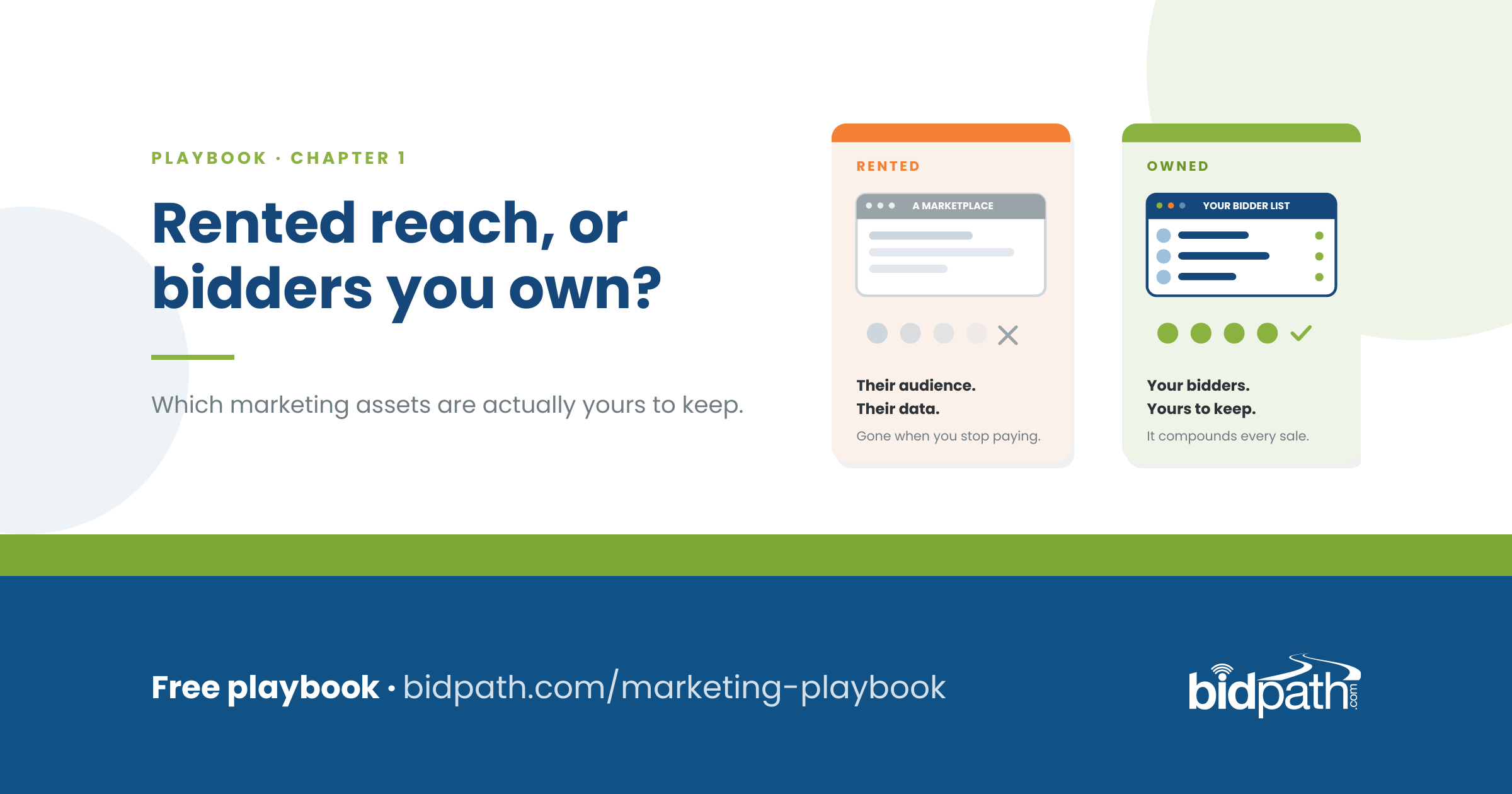
The useful way to sort this is to ask what survives a change in terms. Rented things stop the day someone else decides they should. Owned things keep working, and get more valuable the longer you hold them.
Rented, taken back when the deal changes
Marketplace placement
Bought ad traffic
Borrowed reach on a social feed
Buyer relationships held by someone else
Owned, compounds year after year
Your bidder list
Your reputation and brand
Your data and analytics
Your consignor and contractor network
The operators who come through the next few years in good shape will be the ones who deliberately moved value from the left column into the right one before they were forced to. That does not mean walking away from marketplaces. Most auctioneers run both, at least for a while, and that is a perfectly sound position, as long as the marketplace is doing a job you have chosen for it, such as reach into a category you cannot get to yet, rather than being the only way buyers can find you.
How exposed are you right now?
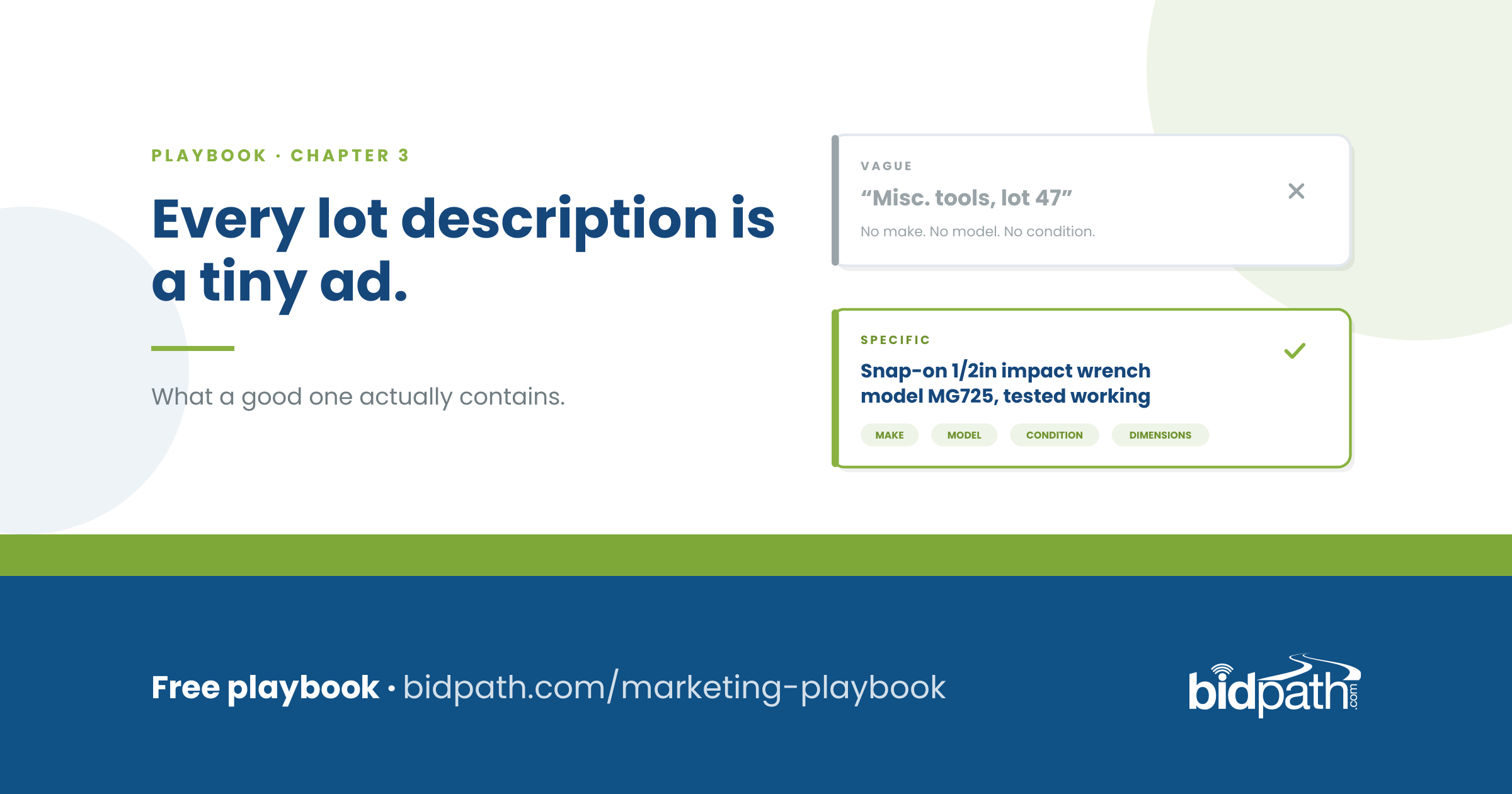
There is a quick version of this you can do without pulling a single report. Think about your last three sales. Roughly what share of the bidders came from a marketplace audience, and what share came from people who already knew you: past buyers, your own website, a consignor's network, someone who saw the sale advertised locally?
That percentage is your exposure. It does not need to be precise to be useful. If nine out of ten bidders reached you through a platform you do not control, you have a dependency worth working on. If the split is closer to even, you have a base to build on. Either way, the number to watch over the next year is not the absolute figure but the direction: is your share of direct bidders going up?
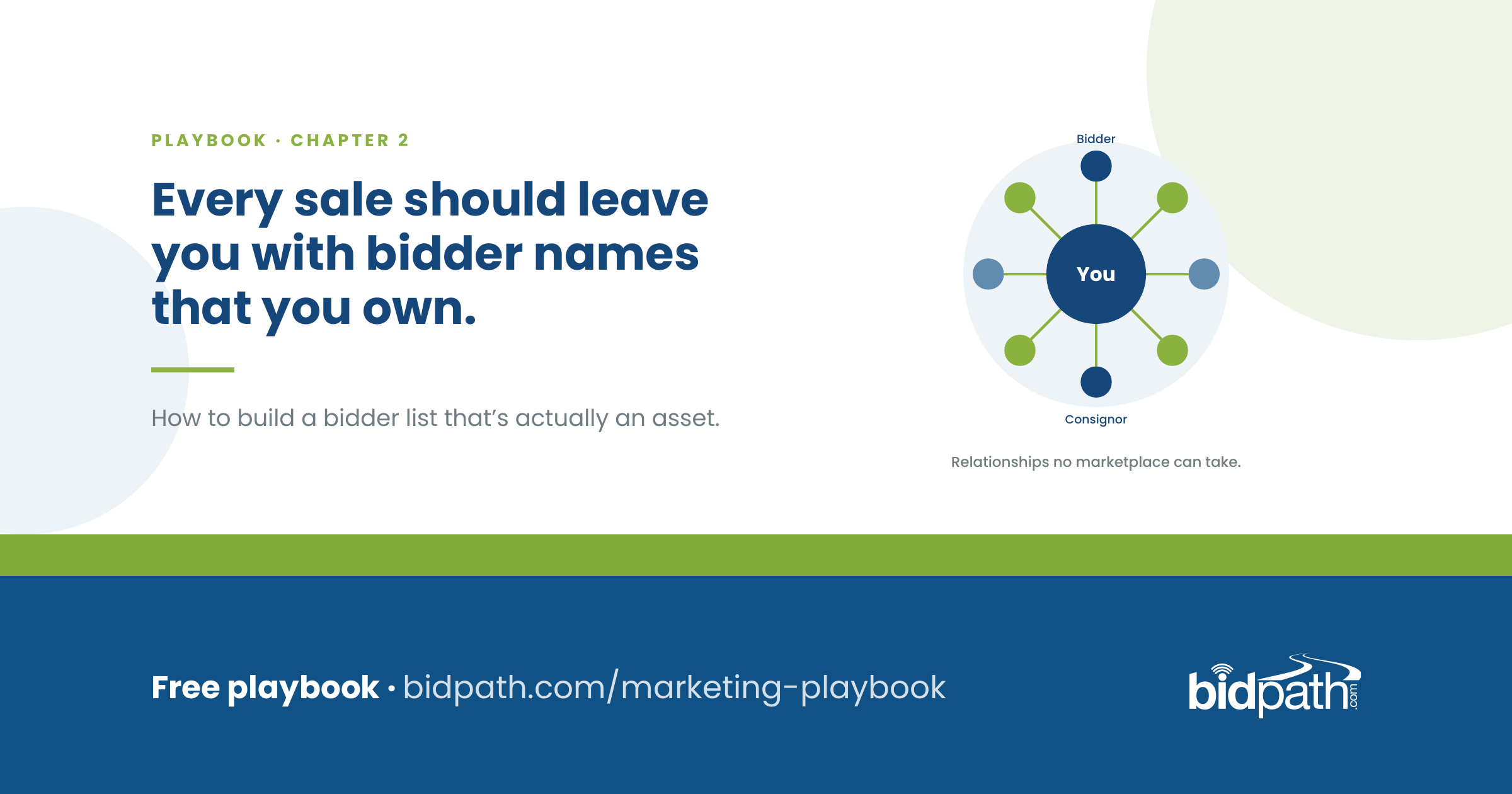
Everything in the chapters that follow drives that one number down or up. Building a bidder list you actually own is where it starts. Making your listings findable by search and AI tools is what brings new buyers to you directly rather than through an intermediary. And the fee comparison at the end of the series is what turns the argument into a number you can take to a decision.
Share of dollars transacted on the auctioneer's own platform
~80%
Outside marketing spend, as a share of hammer
~1.4%
What a marketplace typically charges
3–5%+
Questions auctioneers are asking
Should I stop listing on marketplaces altogether?
No, and that is not what this argues. Marketplaces do a job: they put your lots in front of buyers you have no other route to. The test is whether you chose that job deliberately, or whether the marketplace has become the only way anyone finds your sales. Running both is normal and sensible. Depending entirely on one is the risk.
Which bidder contacts do I actually own?
Anyone who has registered, bid, or won directly through your own sales: your own website, your own timed auctions, your back-office and settlement records, and the paper in your filing cabinet. Buyers who only ever reached you through a marketplace are the ones you do not own, because those platforms generally release only what is needed to complete the transaction.
Do I need a marketing team to do any of this?
No. The tools that used to require a marketing department now fit in the hands of one operator. What it takes instead is a handful of repeatable habits run consistently, which is what the rest of this series sets out, one chapter at a time.
How will I know it is working?
Watch three numbers each quarter: your repeat-bidder percentage, your direct registrations, and the growth of the email list you own. If repeat bidders and direct registrations are climbing, the strategy is working, whatever else is happening around it.
Get the whole playbook, not just this chapter
Nine chapters, a 90-day starter plan, a lot-listing checklist and a worksheet for running your own fee math. Written for independent auctioneers, and free to download.
Next in the series: how to build a bidder list that is actually an asset. In the meantime, you can see how the Bidpath suite fits together or talk to our team.
Read More


🚀 Ready to Elevate Your Auction Tech?
Bidpath is helping auctioneers worldwide modernize operations with customizable, reliable software. Contact our team to discuss your needs, or explore our auction solutions. For more insights and news, visit our blog or follow us on LinkedIn.