
Auction Myth Busters: 5 Auction Tech Myths from the Bidpath & NAA Webinar
On Tuesday, April 28, during National Auctioneers Week, Bidpath partnered with the National Auction Association to host Auction Myth Busters: What’s Real, What’s Not, and What Matters for Auctioneers in Today’s World. Presented by Scott Downes and Joanne Carncross, the session took aim at five of the most common assumptions shaping auction technology decisions right now — and looked at what auctioneers should actually be paying attention to as the market evolves.
Key takeaways
- AI augments auctioneers, it doesn’t replace them. The real value is efficiency, structured content for AI search, and first-party data — not robot auctioneers.
- Marketplaces are a channel, not a strategy. They extend reach, but trade away control of bidder relationships, data and margin.
- Online presence is now table stakes. Growth comes from structured data, multi-channel discovery and ownership of your audience.
- A marketplace and a technology partner have different goals. One is incentivised to grow take rates from your transactions; the other is incentivised to grow your business.
- Strategic technology pays itself back. Capturing direct buyers on your own platform turns saved commissions into reinvestment.
What the Session Covered
Auctioneers are being asked to make faster, more strategic decisions about technology than at almost any point in the industry’s history. AI, marketplace dependency, bidder discovery and platform strategy are reshaping how auction businesses grow — but a lot of the conversation around these topics is built on assumptions that don’t always hold up under scrutiny.
The webinar walked through five myths that come up consistently in conversations with auctioneers and tested each one against current market realities.
Myth 1: Will AI Replace Auctioneers?
This isn’t the first wave of technology to spark replacement anxiety in the industry. Online bidding, digital platforms and live-streaming all triggered the same fear — and each time, the auctioneers who thrived were the ones who used the new tools to amplify what they were already great at.
Where AI actually delivers measurable value is narrower than the headlines suggest: efficiency in cataloguing, structured content for AI and search discovery, and first-party data and insights. The session included a live demo of Bidpath’s PIQ (Photo IQ) cataloguing tool — three lots described in under three minutes from photos alone, with confidence-scored taxonomy fields most auctioneers don’t think to capture today.
“AI replaces typing time. Not expertise.”
Myth 2: Are Marketplaces the Only Way to Reach Bidders?
Marketplaces solved a real problem when they emerged in the early 2000s — they extended reach in a way most auction businesses couldn’t have built independently. But in the years since, many auctioneers have traded control for that reach, and the trade-off has become increasingly one-sided.
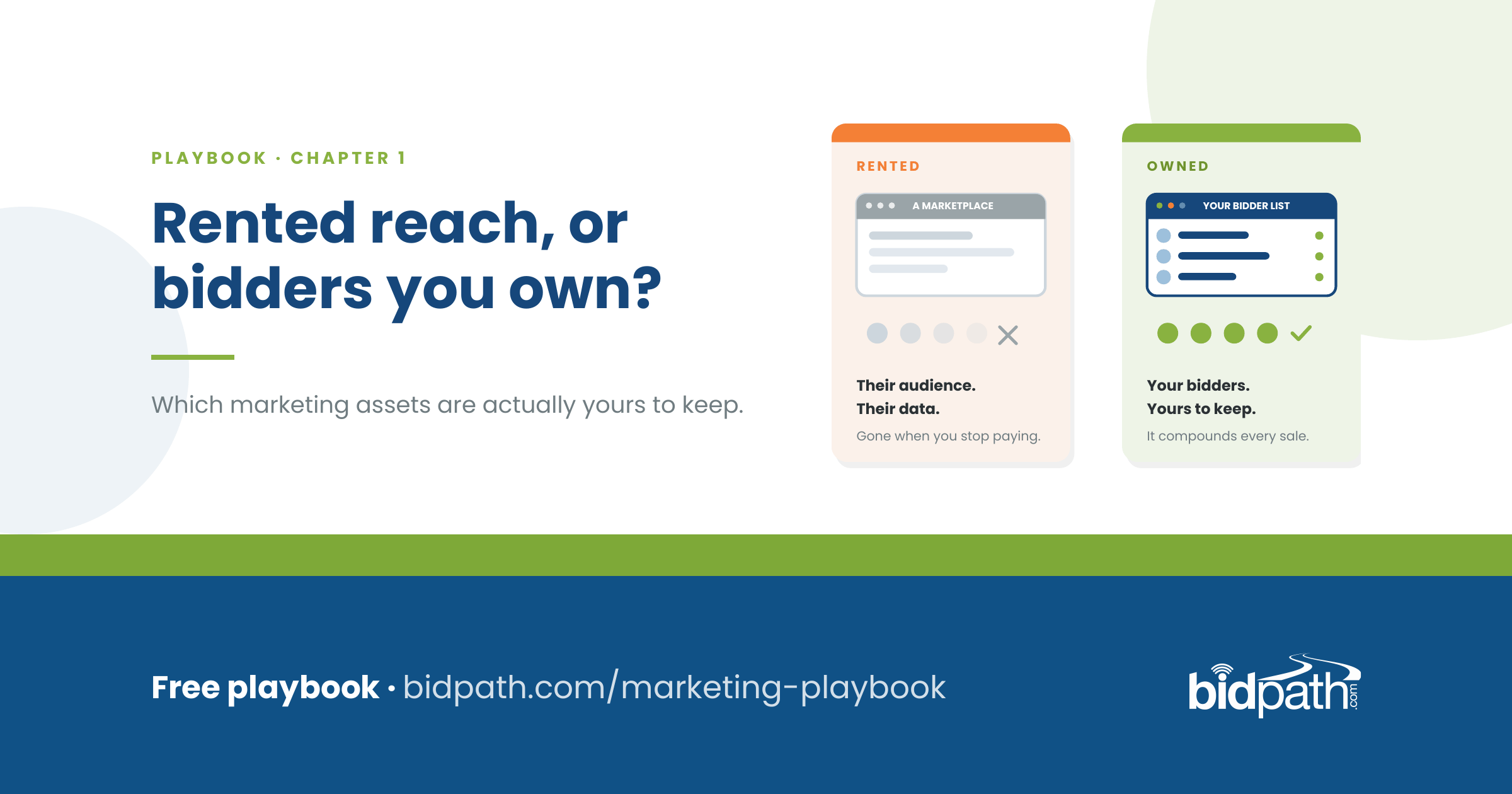
The session walked through the structural realities of marketplace dependency: limited underbidder visibility, no access to maximum bids, restrictions on direct bidder messaging, and a growing imbalance in who actually owns the buyer relationship and the data behind it. Marketplaces are still a useful channel — but they shouldn’t be the strategy.
Myth 3: Is Putting Your Auctions Online Enough?
Online presence is now table stakes. It no longer differentiates anyone. What drives growth in 2026 is structured content, multi-channel discovery and ownership of your data.
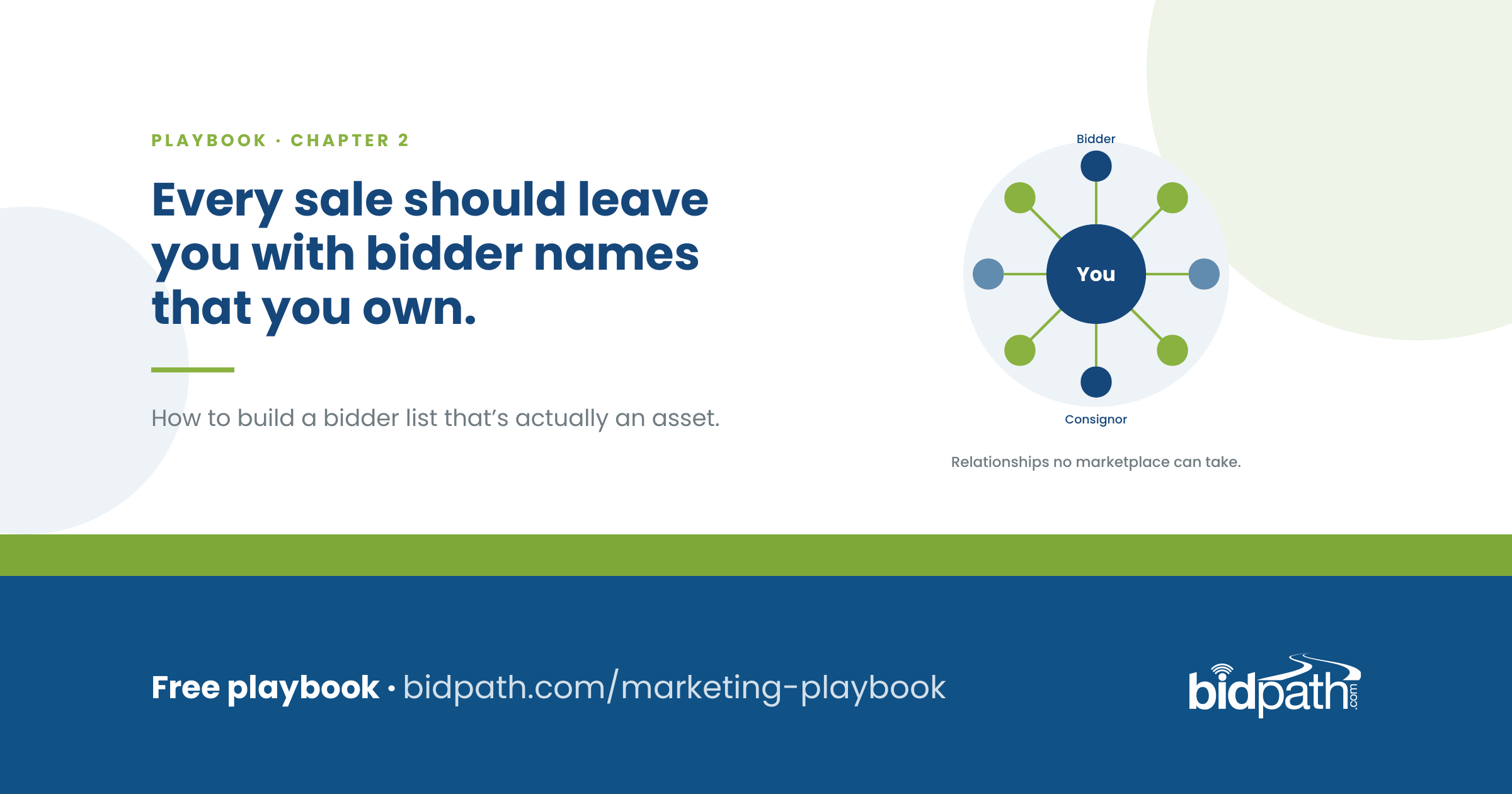
The session introduced a hub-and-spoke discovery model — your platform as the hub, with marketplaces, search, AI, social and email as spokes that all direct back to you. With AI-driven search increasingly surfacing answers rather than lists, the way you structure your data today determines whether AI surfaces your inventory tomorrow. Investing in Answer Engine Optimization (AEO) now is a forward-looking competitive advantage. We covered the same theme from a different angle in Behind Every Great Auction Is a System Nobody Notices.
Myth 4: Are Marketplaces Long-Term Technology Partners?
This one matters more than any other myth on the list. A marketplace and an independent technology partner have fundamentally different business models.
The session reviewed publicly available investor reporting from one of the leading marketplaces, including a stated strategy to “grow the take rate” through value-added services like payments and shipping. In 2025, that same provider acquired a fixed-price direct-to-consumer marketplace with 12,000 sellers — adding a parallel supply channel and an in-house auction business that competes directly with the auctioneers it serves.
The takeaway: marketplaces are incentivised to grow their own business, not yours. A true technology partner should help you build independence, brand equity and long-term enterprise value in your own auction house.
Myth 5: Does More Technology Mean More Cost?
The myth that often stops auctioneers from acting. The reality is closer to the opposite.
Buyers who are already finding you directly — through your website, your marketing, your relationships — frequently end up completing their bids through a marketplace because that’s where the bidding lives. You pay a fee on a buyer you’ve already worked to acquire. Direct bidding technology captures that buyer at the point of conversion and turns saved commission into reinvestment in your team, your marketing and your next sale.
Strategic technology isn’t an added cost line. It’s the difference between paying to grow someone else’s business and reinvesting in your own.
Questions Auctioneers Are Asking
The session closed with a live Q&A. Here are some of the most useful exchanges from the discussion.
If I’m getting strong results from marketplaces, why should I change anything?
If it’s working today, you don’t need to rush. The frame is less about fixing something broken and more about future-proofing what’s working. The risks we discussed in the session aren’t immediate — they build over time. The question is: if costs increase, visibility shifts, or competition intensifies in 12–24 months, how exposed are you? The most successful businesses start building their own audience alongside what’s already working, so they aren’t forced into change later.
What’s the hardest part of making this shift in reality?
Honestly, it’s not the technology — it’s the change in mindset. Most auctioneers are very good at running auctions. Fewer have had to think like marketers, building audiences and nurturing bidders for repeat engagement. The challenge is less “how do I run my platform” and more “how do I consistently bring people back to it?” Once that clicks, the rest tends to follow.
What does a healthy balance between marketplaces and direct actually look like?
It varies by sector, but the goal is to move away from a position where the majority of bidders come from marketplaces. A healthy model is one where your own platform is the primary driver of engagement, and marketplaces are supporting that — bringing incremental bidders rather than being the core source. It’s less about a fixed percentage and more about control: where does your core audience live, and who owns that relationship?
If I want to move in this direction, what should I be measuring?
What you measure tends to drive behaviour. The key things to track: where your bidders are coming from (channel mix), how many are returning vs new, growth of your own database, and cost per bidder acquisition. Over time, you want to see a shift toward more direct engagement and lower reliance on paid or third-party channels — that’s usually the clearest sign you’re building something sustainable.
How do you convince consignors that this approach benefits them?
Consignors care about two things: price and confidence. When you can demonstrate that you have a direct, engaged audience — not just access to a marketplace — it strengthens your position. You can show who your buyers are, how you market assets, and how you create competition. Over time, that becomes a real differentiator when you’re competing for consignments.
Where do you see this going over the next 3–5 years?
A continued split. Marketplaces will remain strong as aggregators and discovery engines, but more auctioneers will invest in building their own ecosystems and direct relationships. The businesses that perform best will be the ones that balance both — using marketplaces for reach but not relying on them for core growth. We covered some of the technology context behind this in our RLA panel discussion on the future of recommerce technology.
Your speakers
17 years in the auction industry, 9 years with Bidpath. Focused on serving auctioneers with technology that protects their brand, data and relationships.
Global Director of Sales at Bidpath. 25+ years in the auction industry, both behind the rostrum and in auction technology.
Take Ownership of the Systems Behind Every Sale
Bidpath’s modular platform helps auctioneers strengthen operations, protect brand visibility and grow on their own terms — without giving up control of bidders, data or margin to a marketplace.
Read More




🚀 Ready to Elevate Your Auction Tech?
Bidpath is helping auctioneers worldwide modernize operations with customizable, reliable software. Contact our team to discuss your needs, or explore our auction solutions.
For more insights and news, visit our blog or follow us on LinkedIn.